Letters, marriage, and republican politics
Abigail Adams
1744–1818 · United States
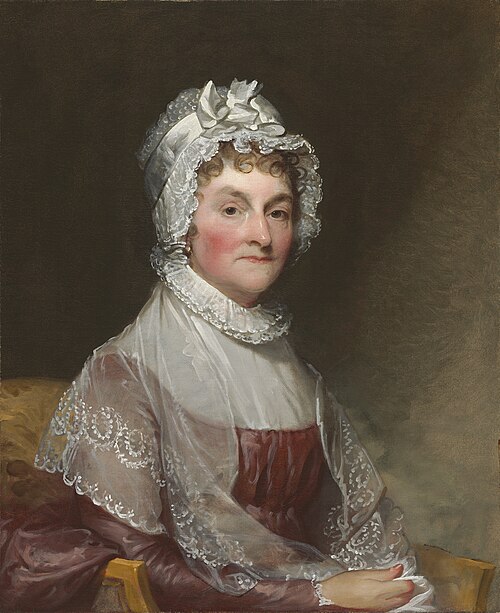
Abigail Smith was born in Weymouth, Massachusetts, in 1744. She was educated at home, reading widely in history and philosophy, and in 1764 she married John Adams, with whom she would raise five children and conduct one of the great correspondences in American letters.
While John was away at the Continental Congress she managed the family farm and finances, reported on events in Boston, and pressed him on the limits of the political order being built. In a letter of March 1776 she asked him to remember the ladies and not to place unlimited power in the hands of husbands, a demand that made her an early voice for women's standing in the republic.
She later joined him in Europe and in the new capital, where she observed politics at close range and wrote with unsparing clarity about the leaders around her. She died at Quincy in 1818, and her letters remain among the fullest records of the founding era.
Gilbert Stuart · Public domain
Known for
Remember the ladies
Abigail Adams's 1776 demand that the new code of laws not leave women at the mercy of their husbands.
In March 1776, while the Congress debated independence, Abigail Adams wrote to her husband that in the new code of laws she hoped he would remember the ladies and be more generous and favorable to them than his ancestors. She warned that women would not hold themselves bound by laws in which they had no voice.
John answered lightly that men would fight the despotism of the petticoat, and the exchange has been read ever since as the moment the question of women's rights entered the American founding. The laws of the new states in fact kept married women under coverture, but Abigail's argument gave later advocates a founding text.
The republican mother
The idea that women served the republic by raising virtuous citizens, a role that gave them influence and, later, a claim to education.
Eighteenth-century writers often cast women as the guardians of private virtue whose example shaped the men who governed. In a republic that depended on the character of its citizens, that role took on new weight, and it became the argument for educating women.
Abigail Adams embodied the ideal and also pushed against its limits, reading deeply in history and politics and offering her husband detailed political judgment. The phrase republican mother was coined by later historians, but it describes a real shift: women were told their influence mattered, and some of them used that claim to demand more.
Hosted
A salon at Braintree · 1780 · Braintree, Massachusetts
Attended
The president and the sedition laws · 1798 · Philadelphia, Pennsylvania