The papacy and papal politics
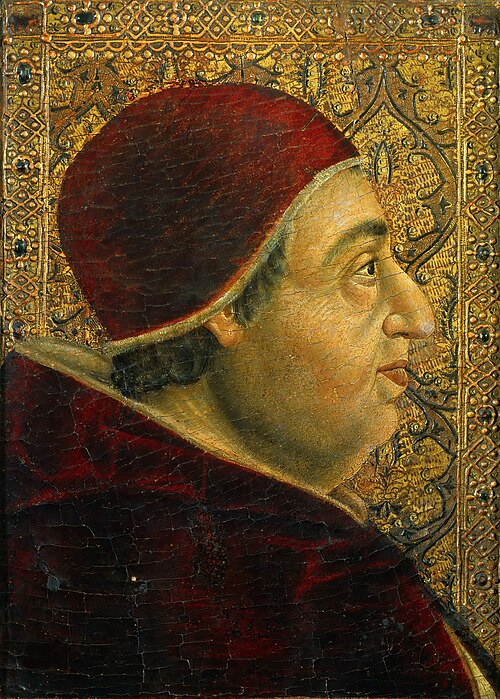
Pope Alexander VI
1431–1503 · Spain
Rodrigo de Borja was born near Valencia in 1431 into a family with a taste for preferment. He studied law in Bologna, was made a cardinal by his uncle, and spent decades in the Roman curia accumulating offices and wealth before he was elected pope in 1492.
As Alexander VI he pursued a policy of family advancement, promoting his son Cesare and marrying his daughter Lucrezia into the ruling houses of Italy. He drew lines of division between Spain and Portugal in the New World and worked to strengthen the papal states, but the means he used — simony, intrigue, and force — gave his reign a reputation it has never shed.
He was a patron of artists and a capable administrator, and his diplomacy kept Rome at the center of Italian affairs. He died in 1503, shortly after dining with a cardinal who also died, and the Borgia power collapsed within days. Later accounts turned him into a villain; the record is more mixed and more disturbing than the legend.
Attributed to Pedro Berruguete · Public domain
Known for
The papal states
The territories the popes ruled directly, and the military and diplomatic power that came with them.
For centuries the popes had claimed a band of territories across central Italy, from Rome and its port to Bologna and the Romagna. In practice local families and vicars governed much of it, and the papacy's authority was often nominal. A determined pope could turn that claim into real power.
Alexander VI set out to do exactly that, using his son Cesare's armies to bring the Romagna to heel and installing loyal governors in place of rebellious lords. The project outlasted him in its effects: Julius II and later popes inherited a more consolidated papal state, and the papacy became a territorial prince as well as a spiritual authority. That double role shaped Italian politics for the rest of the Renaissance.
Papal nepotism
The practice of advancing relatives to wealth and office, which the Borgia papacy raised to a system.
Nepotism takes its name from the nepoti, the nephews and other kin whom popes placed in lucrative offices. The practice was old and widespread: a pope with no legitimate heir could still build a family fortune and a political faction by promoting his relatives.
Alexander VI pursued it more openly than most, making his son Cesare a cardinal and then a general, marrying his daughter Lucrezia into one ruling house after another, and enriching the Borgia family at the church's expense. His reign gave the word its modern meaning, and the outcry that followed helped fuel the calls for reform that became the Reformation.
Hosted
A Borgia table in Rome · 1498 · Rome, Italy
Attended
The first citizen's table · 1455 · Florence, Italy
After the Pazzi conspiracy · 1478 · Florence, Italy
The duke's banquet · 1502 · Rome, Italy