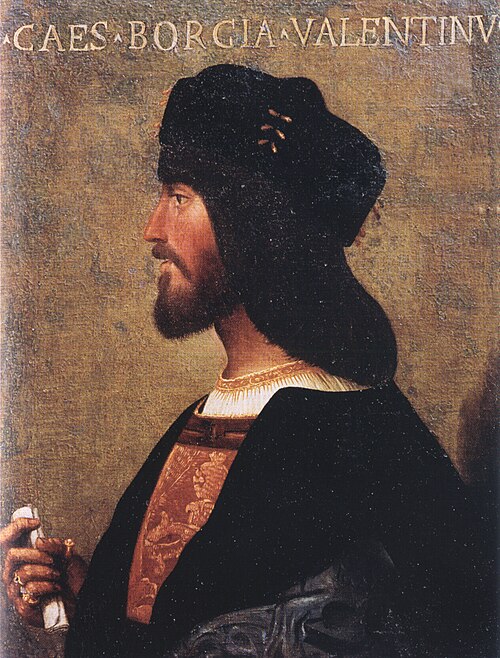
Warfare, politics, and the papacy
Cesare Borgia
1475–1507 · Italy
Cesare Borgia was born in Rome in 1475, the son of Cardinal Rodrigo Borgia, and was pushed toward the church from childhood. He was made a bishop and then a cardinal while still in his teens, but he had no taste for the ecclesiastical life.
When his father became Pope Alexander VI in 1492, Cesare surrendered the cardinal's hat and took up arms. With papal money and French support he campaigned through the Romagna, taking one town after another and appointing a lieutenant, Leonardo da Vinci, as his military engineer. Machiavelli observed him during these years and made him the model for the prince who relies on his own arms.
His fortunes were tied to his father, and when Alexander died in 1503 the new pope turned against him. He was arrested, escaped, and died in 1507 fighting in Spain for his brother-in-law, his state already dissolved.
After Bartolomeo Veneto · Public domain
Known for
The condottieri
The mercenary captains who sold their armies to the Italian states and who, Machiavelli argued, could never be trusted.
The rich Italian states of the fifteenth century hired professional captains, the condottieri, to fight their wars rather than arming their own citizens. These commanders brought trained troops and experience, but their loyalty was to their contract and their own fortunes, and a long campaign was often more profitable to them than a decisive victory.
Machiavelli drew a hard lesson from this: a prince who depends on mercenaries is never secure, because they will abandon him when the price is right or turn on him when he is weak. Cesare Borgia's answer was to raise his own troops and appoint his own officers, and it was this self-reliance, more than his cruelty, that Machiavelli singled out for praise.
The Borgia legend
How the Borgia family became the byword for Renaissance corruption, and what the record actually shows.
The Borgias have come down to us as poisoners, liars, and sensualists, a family that turned the papacy into a private enterprise. Much of that reputation was built by their enemies: the Florentine historians, the della Rovere popes who succeeded them, and later writers who preferred a vivid scandal to a dull record.
The documented facts are damning enough — Alexander VI advanced his children openly, Cesare changed sides as it suited him, and the family used force and money without scruple. But the legend exaggerates and simplifies, turning complex political operators into melodramatic villains. The Borgias were extreme examples of a system, not a sudden moral collapse.
Hosted
The duke's banquet · 1502 · Rome, Italy
Attended
A countess holds her court · 1490 · Forlì, Italy
A Borgia table in Rome · 1498 · Rome, Italy