Empire and Habsburg rule
Charles V
1500–1558 · Spain
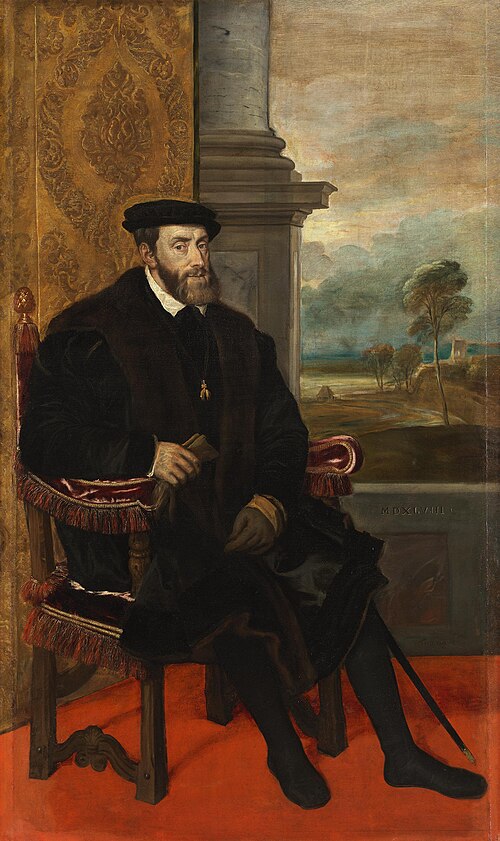
Charles was born in Ghent in 1500 and inherited an extraordinary collection of titles: the Netherlands, Spain and its American empire, the Austrian lands, and in 1519 the Holy Roman Empire. He was, by the standards of the age, the most powerful ruler in Europe.
His reign was a long defense of that inheritance. He fought France in Italy and the Low Countries, held the Ottoman advance at Vienna, and confronted the Lutheran movement that divided the empire he was supposed to keep whole. At Augsburg in 1530 he tried and failed to reconcile the confessions, and he spent his last campaigns in North Africa and Germany.
Exhausted and in poor health, he abdicated in 1555 and 1556, dividing his lands between his son Philip and his brother Ferdinand, and retired to the monastery of Yuste in Spain, where he died in 1558. His reign fixed the shape of European politics for a century.
Attributed to Titian · Public domain
Known for
The Habsburg empire
The patchwork of kingdoms Charles V inherited and the impossible task of ruling them as one.
Charles V's empire was not a single state but a collection of inheritances held together by his person: the Netherlands, Spain and its American colonies, the Austrian lands, the kingdoms of Naples and Sicily, and the elective dignity of the Holy Roman Empire. Each had its own laws, languages, and estates, and each expected to be governed in its own way.
Ruling such a patchwork meant constant travel, negotiation, and delegation, and wars on several fronts at once. Charles spent his reign trying to hold the inheritance together and ultimately conceded that he could not. When he abdicated, he divided it between his son and his brother, and the Spanish and Austrian branches of the Habsburgs went their separate ways.
Empire and Reformation
The collision between the emperor's duty to defend the church and the Protestant movement he could not suppress.
As Holy Roman Emperor, Charles V was the secular defender of the Catholic Church, yet his German lands were the cradle of the Protestant Reformation. He summoned Luther to Worms in 1521 and condemned him, but the political support Luther enjoyed among the German princes made the edict impossible to enforce.
For decades Charles tried to reconcile the confessions and, when that failed, to impose a settlement by force, while France and the Ottomans kept him occupied elsewhere. The Peace of Augsburg in 1555 gave the princes the right to determine their territories' religion, a recognition that the empire could not be unified in faith. It was a settlement by exhaustion, and it held only until the next century.
Hosted
The Diet at Augsburg · 1530 · Augsburg, Germany
Attended
A supper near Calais · 1520 · Calais, France
An evening at Fontainebleau · 1535 · Fontainebleau, France