Banking, Florentine politics, and patronage
Cosimo de' Medici
1389–1464 · Italy
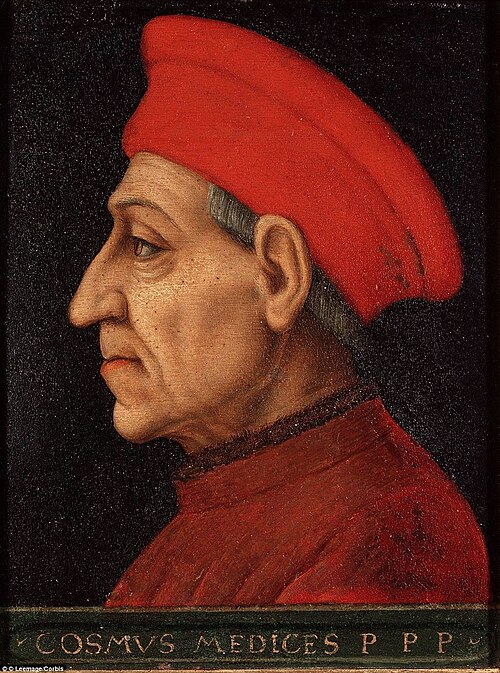
Cosimo de' Medici was born in Florence in 1389 into a family of bankers that had already begun to accumulate wealth. He inherited the bank at a moment when Florence was a republic of competing factions, and he learned early that money could buy influence without ever holding office.
For most of his life he governed the city indirectly, through allies, loans, and the careful distribution of patronage. Exiled once by a rival faction, he returned in triumph within a year and thereafter arranged the republic's elections so quietly that Florence remained a commonwealth in name while he was its first citizen in fact.
He spent a fortune on churches, libraries, and scholarship: he funded the convent of San Marco, collected manuscripts, and supported the scholars who revived the study of Plato. The Palazzo Medici and its chapel were built to his commission, and the artists and humanists he employed set the terms for the Renaissance that his grandson would inherit. He died in 1464, honored as Pater Patriae.
Workshop of Bronzino · Public domain
Known for
Medici patronage
The Medici habit of spending banking fortunes on churches, libraries, and artists — and the political return they expected on the investment.
The Medici were bankers before they were rulers, and they understood that in a republic, wealth could not be displayed as lordship. Patronage was the answer: a fortune spent on churches, convents, manuscripts, and artists looked like civic generosity rather than ambition, and it bound the city's most gifted people to the family that paid them.
Cosimo funded San Marco and its library, collected Greek and Latin manuscripts, and supported the scholars who revived Plato. The buildings and altarpieces he commissioned were public statements as much as private devotions, and they made Florence the visual capital of the early Renaissance. What began as an investment in reputation became a family tradition that his descendants carried on for generations.
The Florentine republic
Florence's republican institutions and the Medici art of controlling them from behind the scenes.
Florence governed itself through a maze of councils, short terms, and lotteries designed to prevent any one man from holding power for long. The system was jealously defended, and its citizens believed that liberty depended on it. Yet in practice a family with enough money and friends could guide the outcome of elections without ever overturning the forms.
Cosimo de' Medici perfected this arrangement. He held office only briefly and was exiled once, but through loans, alliances, and the quiet placement of supporters he decided who sat in the councils. Florence remained a republic in its laws and a Medici domain in its politics, a contradiction that lasted until the family finally took formal power.
Hosted
The first citizen's table · 1455 · Florence, Italy