Kingship, war, and Renaissance patronage
Francis I of France
1494–1547 · France
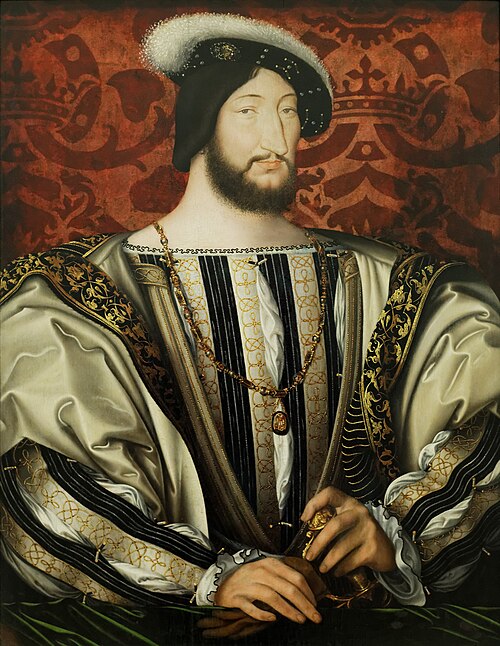
Francis was born in 1494 and came to the French throne in 1515, the year he led an army over the Alps and won the battle of Marignano. He was young, ambitious, and determined to make France the equal of the Italian states in war and in culture.
He invited Italian artists to France, above all Leonardo da Vinci, who spent his last years in the king's service, and he rebuilt and decorated the châteaux of the Loire in a style that mixed French and Italian forms. He founded the Collège de France and collected books and paintings on a scale that made Fontainebleau a capital of the northern Renaissance.
His rivalry with Charles V dominated his foreign policy: the two fought four wars over Italy and the imperial succession, and Francis even allied with the Ottoman sultan to check Habsburg power. He died in 1547, having transformed the culture of his court and left France the strongest monarchy in Europe.
Jean Clouet · Public domain
Known for
The Valois court
The French court of Francis I, where Italian artists and French chivalry were fused into a new style.
Francis I made his court the most splendid in northern Europe. He brought Italian artists across the Alps — Leonardo da Vinci spent his last years at the French court — and set them to work alongside French craftsmen on the châteaux of the Loire and on Fontainebleau, where the mixing of styles produced something new.
The court was also a political instrument. Ceremonies, tournaments, and the elaborate etiquette of the royal household displayed the king's magnificence and bound the nobility to him. Francis's patronage of scholars and his founding of the Collège de France gave the French Renaissance its intellectual center, and the image of the king as a patron of genius outlived him.
The Renaissance in France
The northern Renaissance as it took root in France: châteaux, libraries, and a king who collected genius.
The Italian wars brought French armies into contact with the art and learning of Italy, and the encounter changed French culture. Returning nobles and clerics carried back books, paintings, and ideas, and the court became a market for Italian artists and humanists.
Francis I turned that taste into policy. He collected manuscripts and founded a royal library that became the nucleus of the Bibliothèque nationale, established chairs for Greek and Hebrew, and rebuilt royal residences in the new style. The French Renaissance was never a copy of the Italian: it kept the châteaux and the chivalric culture of France and dressed them in classical forms.
Hosted
A supper near Calais · 1520 · Calais, France
An evening at Fontainebleau · 1535 · Fontainebleau, France