War, revolution, and liberal politics
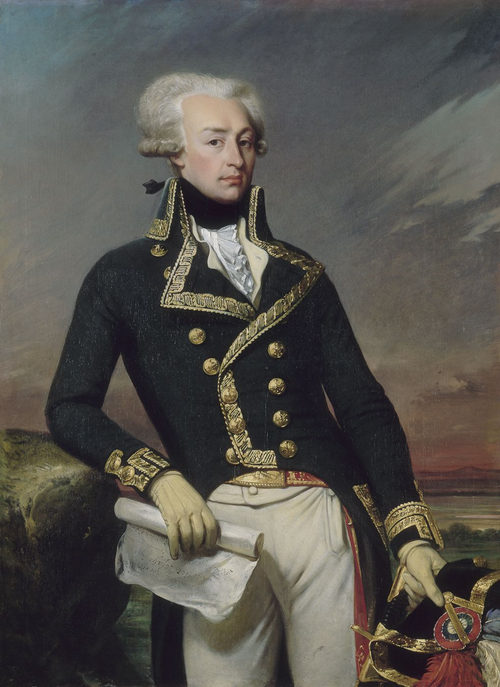
Marquis de Lafayette
1757–1834 · France
Lafayette was born in 1757 into one of the oldest noble families of France and was commissioned an officer as a boy. Fired by the American cause, he fitted out a ship at his own expense and sailed in 1777 to offer his services to Congress, which made him a major general at nineteen.
He fought at Brandywine and Monmouth, wintered at Valley Forge, and became a trusted aide to Washington, whose friendship he kept for life. In 1779 he returned to France to press for a larger French commitment, and in 1781 he commanded the troops that helped trap Cornwallis at Yorktown.
Back in France he became a leader of the liberal nobility, drafted the Declaration of the Rights of Man and of the Citizen with Jefferson's advice, and tried to steer the Revolution toward a constitutional monarchy. He was imprisoned during the Terror, later sat in the Chamber of Deputies, and in 1824 made a triumphal tour of the United States. He died in Paris in 1834.
Joseph-Désiré Court · Public domain
Known for
The French alliance
Lafayette's work as a bridge between the American cause and the French court that supplied the decisive help.
Lafayette's value to America was not only military. As a French nobleman with access to the court, he lobbied for a larger French commitment and helped persuade the government to send troops under Rochambeau and a fleet under de Grasse.
The alliance he helped build trapped Cornwallis at Yorktown in 1781 and ended the war in America's favor. The bond between the two revolutions that Lafayette embodied would later strain when France's revolution turned radical, but the Franco-American treaty remained the new nation's first and only formal alliance.
The Rights of Man and of the Citizen
The 1789 French declaration, drafted with Jefferson's advice, that proclaimed liberty, equality, and popular sovereignty.
In July 1789 Lafayette presented to the National Assembly a draft declaration of rights, written with the help of Jefferson, then America's minister in Paris. It proclaimed that men are born free and equal in rights, and that law is the expression of the general will.
The Declaration of the Rights of Man and of the Citizen became the founding text of the French Revolution and a model for liberal constitutions in Europe and Latin America. Lafayette hoped it would produce a constitutional monarchy on the American pattern, but the Revolution went further than he intended, and he fled France after being accused of betrayal.
Hosted
The young Frenchman's supper · 1781 · Philadelphia, Pennsylvania