Philosophy, mathematics, and natural philosophy
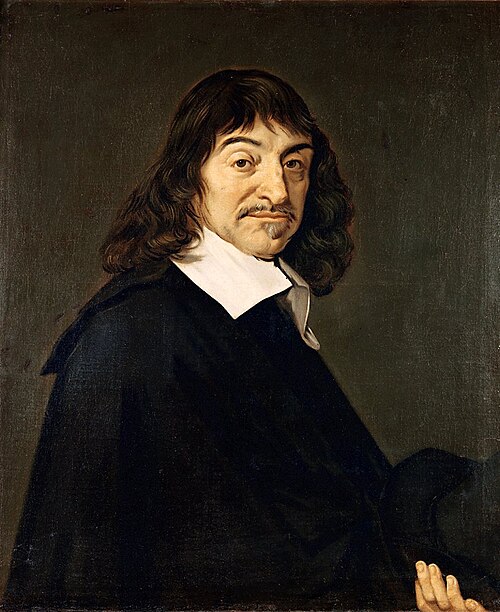
René Descartes
1596–1650 · France
Descartes was born in Touraine in 1596, educated by Jesuits, and trained in law before a career as a soldier and a gentleman of independent means. He spent much of his adult life in the Dutch Republic, moving often to protect his privacy.
He began philosophy again from the ground up. Doubting everything that could be doubted, he found one certainty — that he was thinking — and rebuilt from there a proof of God and of the external world. Discourse on the Method and Meditations on First Philosophy made the thinking self the starting point of modern philosophy.
He also joined algebra to geometry in coordinate mathematics and wrote on optics, the passions, and the body. Invited to Sweden to tutor Queen Christina, he died in Stockholm in 1650, in a climate he disliked.
After Frans Hals · Public domain
Known for
Cartesian doubt
Descartes' method of doubting everything that can be doubted until he reaches the one certainty that he is thinking.
Descartes set out to rebuild knowledge by refusing to accept anything he could not establish for himself. He doubted the evidence of the senses, since they sometimes deceive; he doubted even mathematics, by imagining an all-powerful deceiver who might make him err in the simplest reasoning.
What survived was the act of doubting itself. To be deceived, he had to be thinking, and to be thinking he had to exist. Cogito, ergo sum — I think, therefore I am — became the first certainty, and the foundation from which he tried to prove God and the reality of the material world. The method made the knowing subject, rather than the world, the starting point of philosophy.
Mind and body
Descartes' separation of thinking substance from extended substance, and the puzzle of how the two interact.
Descartes concluded that there are two kinds of substance: thinking substance, which is not extended in space, and extended substance, which occupies space and obeys mechanical laws. The mind is the first, the body the second, and on his account a person is a union of the two.
The separation gave later science a free hand to describe the body as a machine, but it left an obvious difficulty. If mind and body are utterly different, how does a decision move a limb, or a wound produce pain? Descartes located the interaction in the pineal gland, an answer that satisfied few, and the mind-body problem he framed has occupied philosophy ever since.
Hosted
The method in Paris · 1640 · Paris, France
Attended
An evening at Bellosguardo · 1628 · Florence, Italy
A last conversation at Arcetri · 1638 · Arcetri, near Florence