Printing, natural philosophy, and diplomacy
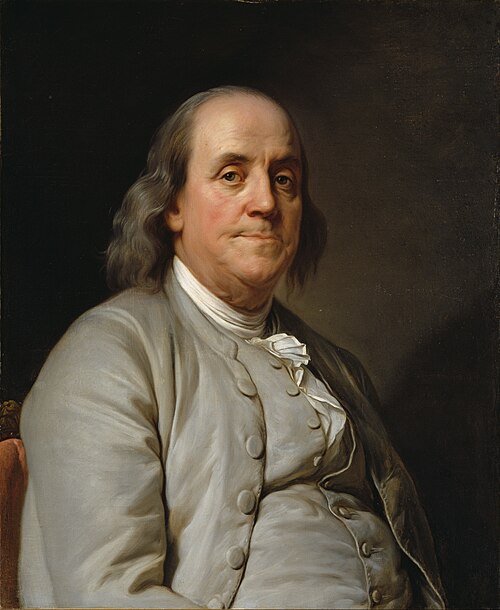
Benjamin Franklin
1706–1790 · United States
Franklin was born in Boston in 1706, the fifteenth child of a soap-and-candle maker, and was apprenticed to his brother's printing shop as a boy. He ran away to Philadelphia, built a printing business, and made his fortune publishing the Pennsylvania Gazette and Poor Richard's Almanack, whose proverbs about thrift and industry became the common currency of American self-improvement.
He retired early to study nature and public affairs. His experiments with electricity, above all the identification of lightning as an electrical discharge and the invention of the lightning rod, won him international fame and election to the Royal Society. He also founded a lending library, a fire company, and a philosophical society, and helped establish the University of Pennsylvania.
As a colonial agent in London and then as a diplomat in Paris, he argued the American cause before the courts of Europe, and in 1778 he secured the French alliance that made independence possible. He helped negotiate the peace of 1783 and then, at eighty-one, attended the Constitutional Convention, where his calls for compromise helped hold a divided gathering together. He died in Philadelphia in 1790.
Joseph-Siffred Duplessis · Public domain
Known for
Franklin's electricity
The kite, the key, and the theory that lightning is an electrical discharge — and the practical lightning rod that followed.
Franklin began experimenting with electricity in the 1740s after a demonstration in Boston, and he developed the idea that electricity is a single fluid present in excess or in deficit, which he called positive and negative. He showed that a pointed conductor could draw off a charge silently and that a Leyden jar could store it.
His most famous experiment, flown with a kite in a thunderstorm, was designed to show that lightning is an electrical discharge rather than a supernatural event. The finding was dangerous and was soon superseded by safer methods, but the lightning rod that grew from it protected buildings on two continents. It was the first great American contribution to physical science.
Civic improvement
Franklin's habit of founding the institutions a city needs — a library, a fire company, a college — and his conviction that the public good is built by association.
Franklin believed that a city improves when its citizens organize themselves, and he spent much of his life proving it. He started the Junto, a club of tradesmen who debated questions of morals and science, and from it came a subscription library, the first in America.
He went on to organize a volunteer fire company, a militia, and an academy that became the University of Pennsylvania, and he raised funds for a hospital. His method was usually the same: find a public need, persuade a few friends to lead, and let the credit be shared. He called this doing well by doing good, and it became a template for American civic life.
The French alliance
Franklin's years in Paris, where his fame and charm turned a cautious monarchy into America's decisive ally.
Sent to Paris in 1776, Franklin found a court willing to help the Americans secretly but not yet openly. He used his scientific reputation and his carefully cultivated image — the plain fur cap, the unpowdered hair — to become the most famous American in Europe, and he let the French believe the cause was winning.
After the American victory at Saratoga, he and his colleagues concluded the treaties of 1778 that brought France into the war with money, ships, and troops. That alliance made independence possible, and Franklin's diplomacy in Paris was as important to the outcome as any battle. He stayed on to negotiate the peace of 1783.
Hosted
A dinner during the Convention · 1787 · Philadelphia, Pennsylvania
Attended
The evening before independence · 1776 · Philadelphia, Pennsylvania
The pamphleteer's table · 1776 · Philadelphia, Pennsylvania
The framer's working dinner · 1787 · Philadelphia, Pennsylvania