Warfare, government, and the Romagna
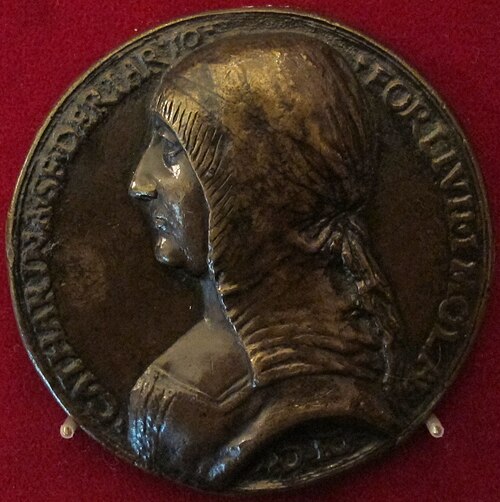
Caterina Sforza
1463–1509 · Italy
Caterina Sforza was born in 1463, an illegitimate daughter of Galeazzo Maria Sforza, duke of Milan, and was married at fourteen into the Riario family, which ruled Imola and Forlì. When her husband was murdered in 1488 she seized the citadel and held it until the conspirators were crushed, an act that made her name.
Widowed and ruling on behalf of her son, she governed the two cities, managed their fortresses, and defended them against repeated attack. She studied medicine and alchemy, kept a court of scholars, and corresponded with the leading figures of her day. When Cesare Borgia invaded the Romagna with French and papal backing, she held out at Forlì until the walls were breached and was taken prisoner.
She was eventually released and spent her last years in Florence, where she died in 1509. Her refusal to submit to the Borgias turned her into a symbol of resistance, and her letters and household books show a ruler as practical as she was fearless.
sailko · CC BY-SA 3.0
Known for
Women and power
The avenues open to noblewomen in Renaissance Italy, and the rulers who took them further than convention allowed.
In Renaissance Italy a noblewoman's route to power usually ran through her family: she governed as a regent for a minor son, held a city as her dowry, or acted for a husband who was absent at war. Convention denied her office in her own right, but a widow with a fortress and a claim could be as formidable as any man.
Caterina Sforza pushed those limits as far as they would go. She ruled Imola and Forlì, negotiated with popes and condottieri, and defended her walls in person. Other women — Isabella d'Este, Lucrezia Borgia, Vittoria Colonna — exercised power through patronage and diplomacy. Their careers show how much a determined woman could achieve within a system designed to keep her out of it.
The Romagna wars
The campaigns that redrew the Romagna as popes, condottieri, and foreign armies fought over its cities.
The Romagna was a stretch of small lordships between Florence, Venice, and the papal states, and for decades it was the battleground on which the papacy tried to convert its nominal claim into real control. Local dynasties resisted, hired condottieri of their own, and played the great powers against one another.
Cesare Borgia's campaigns from 1499 to 1502 broke most of those lordships and made him the most feared captain in Italy. Caterina Sforza's stand at Forlì was one of the few open acts of defiance, and when she fell the region passed under papal control. The wars turned the Romagna into a laboratory for the new statecraft that Machiavelli described.
Hosted
A countess holds her court · 1490 · Forlì, Italy
Attended
After the Pazzi conspiracy · 1478 · Florence, Italy
The garden at San Marco · 1490 · Florence, Italy