Humanism, theology, and scholarship
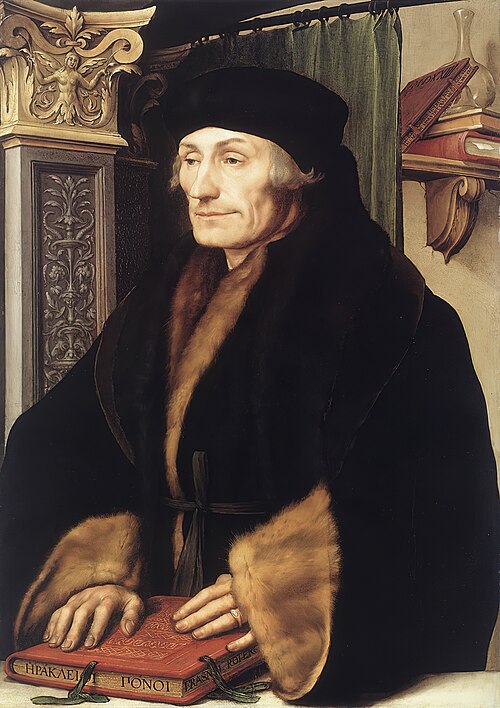
Desiderius Erasmus
1466–1536 · Netherlands
Erasmus was born in Rotterdam around 1466 and raised, after his parents died, in the care of religious houses; he took holy orders but never settled into the life of a monk. He studied in Paris and then moved restlessly between England, Italy, and the Rhineland, living by his pen and by the patronage of friends.
He produced a corrected edition of the Greek New Testament and translations and commentaries that sent scholars back to the original texts, and he wrote satires — above all In Praise of Folly — that mocked the ignorance and corruption he found among churchmen and princes alike. His Adages and his letters made him the most famous scholar in Europe.
He refused to join the Protestant Reformation, arguing for reform from within and for a faith centered on the simple teaching of Christ, and the quarrel with Luther over free will troubled him for years. He died in Basel in 1536, and the humanist program he embodied shaped schools and scholarship for generations.
Hans Holbein the Younger · Public domain
Known for
The printing press
The new technology that let scholars like Erasmus reach a whole continent, and that made the Reformation possible.
Movable-type printing spread across Europe in the second half of the fifteenth century, and by the early 1500s presses in Venice, Basel, Paris, and Antwerp could produce books in quantities no scriptorium had ever managed. A scholar could now see his work read from Spain to Poland within a year.
Erasmus made the press his instrument. His editions, translations, satires, and letters circulated in tens of thousands of copies, and the Greek New Testament he published in 1516 put a tool in the hands of every reformer. Luther's pamphlets proved the same point a few years later: the press made ideas that had once been confined to a few minds impossible to suppress.
Humanist scholarship
The humanist program of returning to original texts and languages, and the tools of editing and translation it produced.
The humanists of the Renaissance believed that the culture of Greece and Rome had been buried under centuries of commentary and that the way to recover it was to read the original texts in their original languages. They learned Greek, collected manuscripts, and developed the philological tools needed to establish what an author had actually written.
Erasmus applied those tools to Christian scripture as well as to classical literature. His editions of the New Testament and the Church Fathers, and his Adages and Colloquies, taught a generation how to compare manuscripts, weigh variants, and translate with precision. The method outlasted the theology and became the foundation of modern textual scholarship.
Hosted
The printer's house · 1520 · Basel, Switzerland
Attended
A study in exile · 1513 · Florence, Italy
A commonwealth imagined · 1516 · London, England
A supper near Calais · 1520 · Calais, France
The Diet at Augsburg · 1530 · Augsburg, Germany
An evening at Fontainebleau · 1535 · Fontainebleau, France