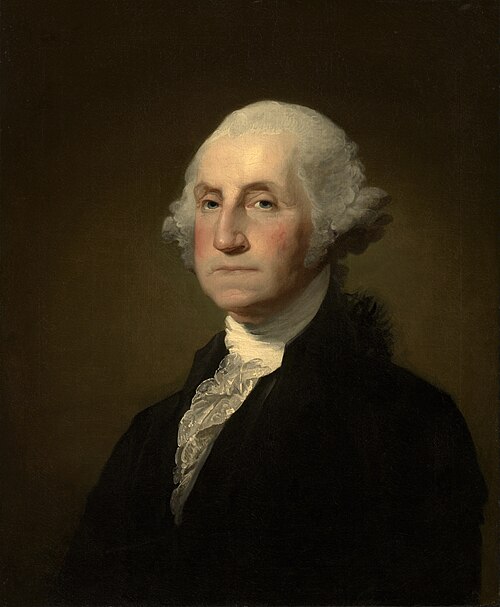
Soldiering, statesmanship, and the presidency
George Washington
1732–1799 · United States
Washington was born in 1732 into a Virginia planting family and trained as a surveyor before he inherited Mount Vernon and took up the life of a gentleman farmer and militia officer. His early service in the French and Indian War gave him a soldier's education and a reputation for steadiness under fire.
When the colonies took up arms in 1775, the Continental Congress chose him to command the army, less for battlefield brilliance than for his gravity and his willingness to serve without pay. He held a ragged force together through years of defeat, and his refusal to become a military dictator at the war's end made him the new republic's most trusted citizen.
He presided over the Constitutional Convention in 1787 and was elected president unanimously the following year. In two terms he established the cabinet, the precedent of a peaceful transfer of power, and the authority of the federal government, then retired voluntarily to Mount Vernon, where he died in 1799.
Gilbert Stuart · Public domain
Known for
The commander in chief
Washington's leadership of the Continental Army, and the example of a general who gave up power when the war ended.
Washington took command at Cambridge in 1775 and spent the next eight years holding together an army perpetually short of men, money, and supplies. He avoided the decisive battle that might have destroyed it, kept his forces in being, and waited for the French alliance and British exhaustion to turn the war.
What mattered as much as his strategy was his character. When a group of officers at Newburgh talked of marching on Congress, he defused the plot with a speech, and at the end of the war he surrendered his commission to Congress rather than to any king. That voluntary return to private life made the army safe for the republic.
The presidential precedent
How Washington's two terms, cabinet, and farewell address defined an office the Constitution had described only in outline.
The Constitution says little about how a president should behave, and Washington invented much of it. He chose a cabinet of department heads, consulted the Senate only on treaties, and adopted a formal but republican style that avoided the trappings of monarchy.
Most importantly, he retired after two terms, establishing a limit that lasted until Franklin Roosevelt, and in his farewell address he warned against permanent foreign alliances and against the spirit of party. His willingness to leave office was the precedent on which the peaceful transfer of power came to rest.
Mount Vernon
The Virginia plantation Washington managed for most of his life, and the private world to which he returned after the presidency.
Washington inherited Mount Vernon in 1761 and spent decades expanding it into a working estate of five farms, a gristmill, a fishery, and a mansion he rebuilt in the fashionable neoclassical style. He was a careful, demanding farmer who experimented with crop rotation and tried to move away from tobacco toward wheat.
The plantation rested on the labor of enslaved people, whose work made Washington's public life possible and whose freedom he arranged only in his will. He returned to Mount Vernon after leaving the presidency and died there in 1799, and the house became a national shrine soon after.
Hosted
The general's table at Mount Vernon · 1790 · Mount Vernon, Virginia
The farewell dinner · 1796 · Philadelphia, Pennsylvania
Attended
The evening before independence · 1776 · Philadelphia, Pennsylvania
The young Frenchman's supper · 1781 · Philadelphia, Pennsylvania
A dinner during the Convention · 1787 · Philadelphia, Pennsylvania
The framer's working dinner · 1787 · Philadelphia, Pennsylvania
Publius at table · 1788 · New York, New York