Law, independence, and the presidency
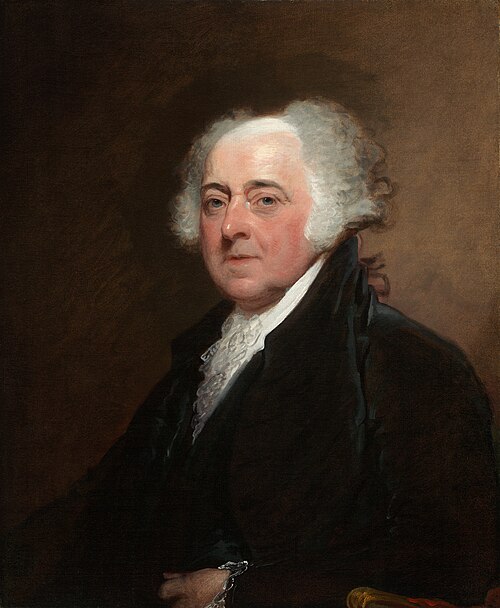
John Adams
1735–1826 · United States
Adams was born in Braintree, Massachusetts, in 1735, the son of a farmer and deacon, and became a lawyer after graduating from Harvard. He defended the British soldiers tried for the Boston Massacre because he believed no one should be denied counsel, and the acquittals he won earned him more respect than popularity.
In the Continental Congress he was among the earliest and most persistent advocates of independence. He nominated Washington to command the army, drafted much of the correspondence that built support for the cause, and helped negotiate the peace of 1783. He served as Washington's vice president and then as president from 1797 to 1801, steering a course between France and Britain that kept the young republic out of a wider war.
His presidency was embittered by the Alien and Sedition Acts and by the rise of party conflict, and he lost the election of 1800 to Jefferson. In retirement he wrote voluminously about government and religion, and he died at Quincy on the Fourth of July, 1826, the same day as Jefferson.
Gilbert Stuart · Public domain
Known for
Independence in Congress
Adams's long campaign in the Continental Congress to turn colonial resistance into a declaration of independence.
Adams arrived in the Continental Congress in 1774 convinced that reconciliation with Britain was a dead end. He wrote and spoke constantly for independence, seconded the resolutions that created the Continental Army, and served on more than eighty committees.
He nominated Washington to command the army and recommended Jefferson to draft the declaration, though he was himself its most persistent advocate on the floor. He called the Fourth of July the most memorable epoch in the history of America, and he spent the rest of his life explaining why the decision had been necessary.
The Alien and Sedition Acts
The laws Adams signed during the quasi-war with France, which made criticism of the government a crime and helped defeat him in 1800.
With war with France threatening in 1798, the Federalist Congress passed four laws that lengthened the residency required for citizenship, allowed the president to deport aliens, and made it a crime to publish false and malicious writing against the government.
Adams signed them and used them sparingly, but the Sedition Act was used to prosecute Republican editors, and the laws became a rallying cry for Jefferson and Madison. Their Virginia and Kentucky Resolutions argued that the states could judge the constitutionality of federal laws, and the backlash helped elect Jefferson in 1800.
Hosted
The evening before independence · 1776 · Philadelphia, Pennsylvania
The president and the sedition laws · 1798 · Philadelphia, Pennsylvania
Attended
A salon at Braintree · 1780 · Braintree, Massachusetts
Publius at table · 1788 · New York, New York
The general's table at Mount Vernon · 1790 · Mount Vernon, Virginia
The farewell dinner · 1796 · Philadelphia, Pennsylvania