Law, humanism, and statesmanship
Thomas More
1478–1535 · England
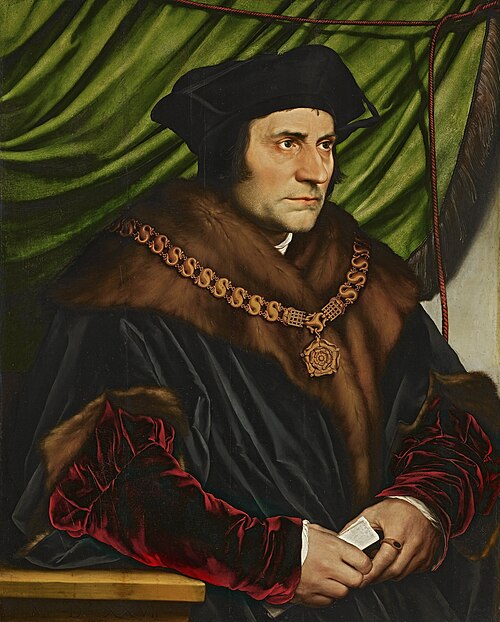
Thomas More was born in London in 1478 and trained as a lawyer, but he moved in the circle of the humanists and became a close friend of Erasmus. He served as a diplomat and legal adviser to Henry VIII, and in 1529 he was made lord chancellor of England.
He wrote Utopia in 1516, a book that describes an imaginary island with no private property and rational, humane institutions, and that leaves the reader to decide how far the satire cuts against England itself. He also wrote polemics against the reformers and spent years arguing for the unity of the church.
When Henry repudiated the pope's authority over his marriage, More resigned his office and refused to swear the oath that recognized the king as head of the church. He was imprisoned in the Tower, tried for treason, and beheaded in 1535, saying that he died the king's good servant but God's first. He was canonized in 1935.
Hans Holbein the Younger · Public domain
Known for
Utopia
More's imagined commonwealth, where property is held in common and institutions are ordered by reason rather than greed.
Utopia, published in 1516, describes a voyage to an island whose people live without private property, work six-hour days, and order their laws, education, and religion on rational principles. The narrator, Raphael Hythloday, contrasts this commonwealth with the England around him, where enclosure and poverty breed crime and idleness.
More wrote the book as a conversation rather than a blueprint, and its name — from the Greek for 'no place' — warns the reader against taking it literally. It can be read as a serious proposal, as a satire on European society, or as a debate about whether a just commonwealth is possible at all. That ambiguity is part of its lasting power.
Conscience and the king
More's refusal to place the king's authority above his own conscience, and the price he paid for it.
When Henry VIII broke with Rome and claimed headship of the Church of England, More resigned as lord chancellor rather than endorse the change. He would not swear to the succession act and the supremacy because to do so would deny the authority he believed Christ had given to the pope.
His stand was one of conscience, not of politics: he refused to attack the king or to explain his reasons, insisting that silence was enough. That silence could not save him. Convicted on perjured evidence, he went to the block in 1535, and his composure at the end made him a lasting symbol of the individual conscience against the state.
Hosted
A commonwealth imagined · 1516 · London, England
Attended
A study in exile · 1513 · Florence, Italy
The printer's house · 1520 · Basel, Switzerland
A supper near Calais · 1520 · Calais, France
The Diet at Augsburg · 1530 · Augsburg, Germany