Physics, astronomy, and the telescope
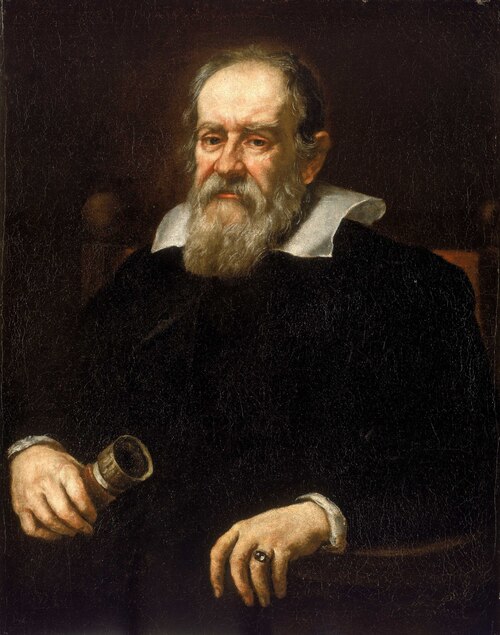
Galileo Galilei
1564–1642 · Italy
Galileo was born in Pisa in 1564, the son of a musician, and taught mathematics at Pisa and then Padua. He was quarrelsome, brilliant, and convinced that the book of nature was written in the language of mathematics.
When he improved the newly invented telescope and turned it on the sky, he saw mountains on the Moon, four moons circling Jupiter, and the phases of Venus — evidence that the heavens were neither perfect nor fixed to the Earth. His Dialogue Concerning the Two Chief World Systems defended Copernicus as a conversation between three speakers, and its arguments were so plainly one-sided that the Inquisition summoned him.
Tried in 1633, he was forced to abjure the motion of the Earth and spent his last years under house arrest at Arcetri, where he wrote the Two New Sciences and laid foundations for the physics of motion. He died in 1642.
Justus Sustermans · Public domain
Known for
Telescopic astronomy
What Galileo saw through his improved spyglass — lunar mountains, Jupiter's moons, the phases of Venus — and why it unsettled the received cosmos.
Galileo did not invent the telescope, but he improved its lenses until it magnified far beyond anything then available, and he was the first to point it systematically at the night sky. He published what he found in Sidereus Nuncius in 1610.
The Moon had mountains and seas, not the smooth perfection claimed for the heavens. Jupiter had four moons of its own, showing that not everything revolved around the Earth. Venus showed phases like the Moon, which fit a planet orbiting the Sun and not a planet circling the Earth. Each observation was a small argument against the old cosmology, and together they made it hard to defend.
Hosted
An evening at Bellosguardo · 1628 · Florence, Italy
A last conversation at Arcetri · 1638 · Arcetri, near Florence
Attended
The music of the spheres · 1618 · Prague, Bohemia
A supper for the new philosophy · 1620 · London, England
The method in Paris · 1640 · Paris, France