Astronomy and planetary motion
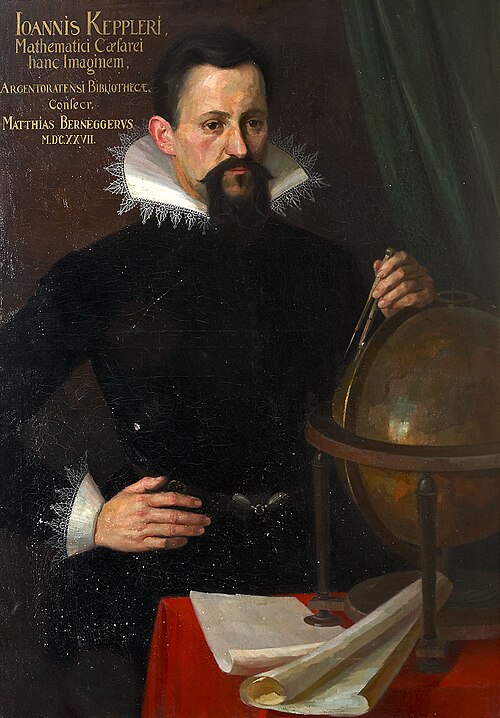
Johannes Kepler
1571–1630 · Germany
Kepler was born in Weil der Stadt in 1571 and trained for the Lutheran ministry before mathematics claimed him. He became an assistant to the astronomer Tycho Brahe, whose meticulous observations of Mars he inherited and spent years trying to fit.
He abandoned the circle for the ellipse, and from that concession came three laws: planets move in ellipses with the Sun at one focus; they sweep equal areas in equal times; and the square of a planet's period is proportional to the cube of its distance from the Sun. Astronomia nova and Harmonices mundi set out the work.
He also cast horoscopes, wrote a speculative voyage to the Moon, and defended his mother against a charge of witchcraft. He died in Regensburg in 1630 while traveling to collect a debt.
August Köhler [1] · Public domain
Known for
The laws of planetary motion
Kepler's three rules: elliptical orbits, equal areas swept in equal times, and the harmony between a planet's period and its distance.
Kepler spent years trying to fit Tycho Brahe's observations of Mars to a circular orbit and failing by a few minutes of arc. Refusing to dismiss the discrepancy, he tried an ellipse and found that it fit, and he never returned to the circle.
From that came three laws. Planets travel in ellipses with the Sun at one focus. A line from a planet to the Sun sweeps out equal areas in equal times, so a planet moves faster when it is nearer the Sun. And the square of a planet's orbital period is proportional to the cube of its average distance from the Sun. The third law gave the solar system a single mathematical order.
Hosted
The music of the spheres · 1618 · Prague, Bohemia
Attended
A supper for the new philosophy · 1620 · London, England
An evening at Bellosguardo · 1628 · Florence, Italy