Mathematics, physics, and religious philosophy
Blaise Pascal
1623–1662 · France
Pascal was born in Clermont in 1623 and was educated at home by a father who recognized his gifts. By his teens he was corresponding with mathematicians; by his early twenties he had built a calculating machine and, with Fermat, laid the foundations of probability.
He studied the vacuum and fluid pressure, wrote on the geometry of conic sections, and helped establish the calculus of probabilities. In 1654 a religious experience turned him toward theology, and he began the fragmentary defence of Christianity published after his death as the Pensées, whose argument for faith by the stakes involved is known as the wager.
He wrote the Provincial Letters in defence of Jansenism, quarrelled with the Jesuits, and died in Paris in 1662 at thirty-nine, leaving notes that became one of the most quoted books in French.
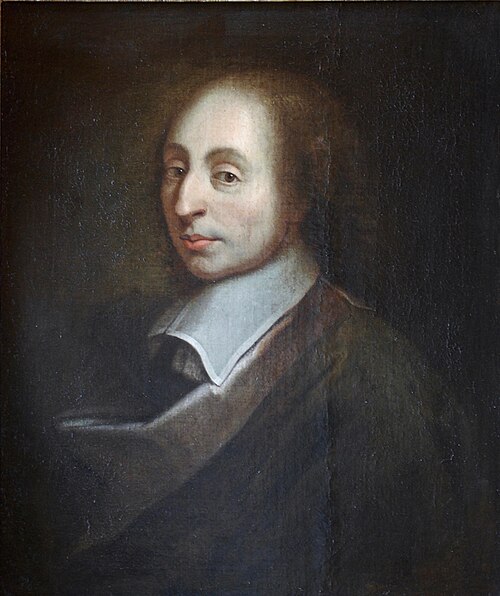
unknown; a copy of the painting of François II Quesnel, which was made for Gérard Edelinck en 1691 [réf. nécessaire] . · Public domain
Known for
The wager
Pascal's argument that reason cannot settle the existence of God, and that the stakes make belief the rational bet.
Pascal held that neither reason nor nature can prove whether God exists, so a decision must be made without certainty. He framed that decision as a wager: if you believe and God exists, you gain everything; if you believe and God does not exist, you lose little; if you disbelieve and God exists, you lose everything.
The argument is not a proof but an appeal to self-interest, and it has been debated ever since — for whether belief can be chosen at will, and for what it assumes about the possible outcomes. In the Pensées it sits beside passages of intense religious feeling, and together they made the book a landmark of Christian apologetics.
Hosted
The wager at Port-Royal · 1655 · Paris, France
Attended
The method in Paris · 1640 · Paris, France