Philosophy of science and natural history
Francis Bacon
1561–1626 · England
Francis Bacon was born in London in 1561, the son of a lord keeper, and rose through the law to become attorney general and then lord chancellor. His public career ended in 1621 when he was convicted of taking bribes and barred from office.
He is remembered instead for his programme for knowledge. In Novum Organum and The Advancement of Learning he argued that the mind is prone to idols and idle systems, and that knowledge should be built patiently from observation and experiment, then put to use for human benefit.
He never produced the comprehensive natural history he promised, and he died in 1626 after an experiment with preserving a chicken in snow. His insistence on method and utility nonetheless shaped the scientific societies that followed.
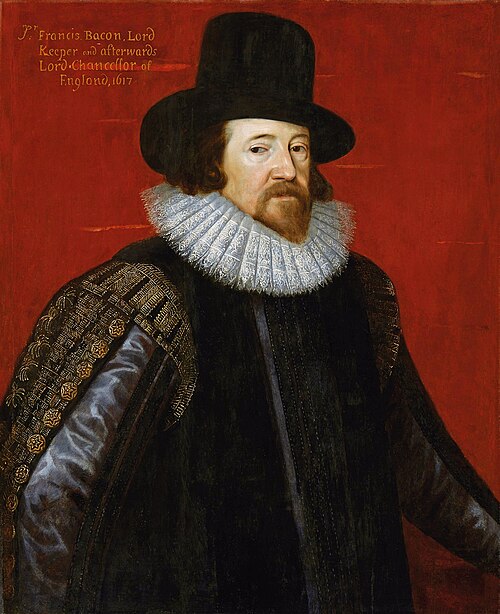
Paul van Somer I / Formerly attributed to Frans Pourbus the Younger · Public domain
Known for
Empiricism and the new method
Bacon's insistence that knowledge be gathered from experiment and observation, not deduced from ancient authority.
Bacon argued that the learning of his day had produced endless commentary but little useful knowledge, because it began from authority and reasoned downward. He proposed the opposite: begin with particulars, gather them patiently into tables, and let general laws emerge from the comparison.
He warned that the mind carries its own obstacles — what he called idols of the tribe, the cave, the marketplace, and the theatre — that lead people to see what they expect. His method was never fully carried out, but the demand that claims be tested against experience became the working assumption of the scientific societies that followed him.
Hosted
A supper for the new philosophy · 1620 · London, England
Attended
The music of the spheres · 1618 · Prague, Bohemia