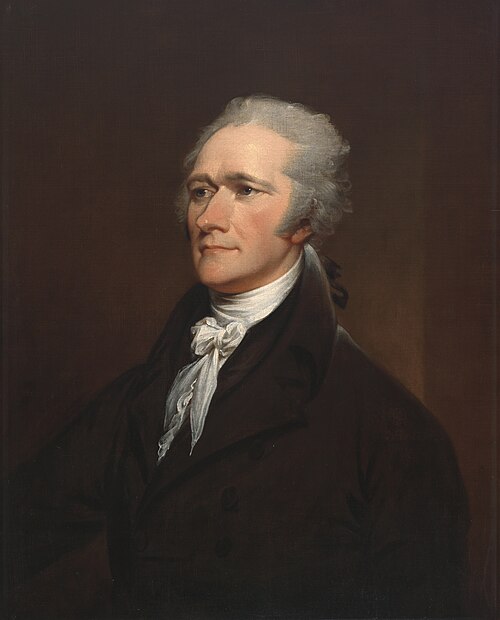
Finance, federalism, and the Constitution
Alexander Hamilton
1755–1804 · United States
Hamilton was born out of wedlock in 1755 on the island of Nevis and raised in St. Croix, where he worked as a clerk for a trading house. A fund raised by local merchants sent him to New York to study, and he was still a student when he began writing pamphlets defending the American cause.
He served as Washington's aide-de-camp during the Revolution and afterward practiced law and argued for a strong central government. With Madison and John Jay he wrote the Federalist Papers, and at the Constitutional Convention he pressed for an energetic executive and a consolidated nation.
As the first secretary of the treasury he assumed the states' war debts, chartered a national bank, and put the country's credit on a firm footing, laying the ground of the Federalist party. He died in 1804 from a wound suffered in a duel with Aaron Burr.
John Trumbull / Giuseppe Ceracchi · Public domain
Known for
The Federalist Papers
The eighty-five essays Hamilton, Madison, and Jay wrote to persuade New York to ratify the Constitution.
Published in New York newspapers during 1787 and 1788, the Federalist essays were written at speed under the pen name Publius to answer the Constitution's critics. Hamilton conceived the project, wrote most of the essays on the executive and the judiciary, and recruited Madison and Jay.
Madison's contributions, especially numbers ten and fifty-one, supplied the deepest defense of the extended republic and the separation of powers. The essays failed to carry New York quickly but became the classic commentary on the Constitution, read ever since as both political argument and political theory.
Assumption and the national bank
Hamilton's financial program: federal payment of state war debts, a national bank, and a mint, built to give the new government credit and a stake in commerce.
As treasury secretary, Hamilton argued that the federal government should assume the states' Revolutionary War debts, fund them at par, and pay them from a steady revenue. The measure tied the creditors' interest to the survival of the union and established the nation's credit abroad.
He followed it with a Bank of the United States, modeled on the Bank of England, to hold public funds and issue a stable currency. Jefferson and Madison objected that the Constitution did not authorize a bank, and the argument over implied powers became the first great constitutional dispute between the parties.
Implied powers
Hamilton's doctrine that the Constitution grants the means necessary to carry out its enumerated ends, and the loose construction that followed.
When Washington asked whether the bank was constitutional, Hamilton answered that the Constitution's power to tax, borrow, and regulate commerce necessarily included the choice of means to do so. A government, he wrote, ought to possess the means of executing its powers.
The doctrine of implied powers, together with the necessary and proper clause, gave Congress room to legislate beyond a literal reading of its enumerated authority. Jefferson's strict construction held that powers not expressly granted were reserved to the states, and the disagreement shaped American constitutional law for two centuries.
Hosted
Publius at table · 1788 · New York, New York
Attended
The young Frenchman's supper · 1781 · Philadelphia, Pennsylvania
A dinner during the Convention · 1787 · Philadelphia, Pennsylvania
The framer's working dinner · 1787 · Philadelphia, Pennsylvania
The general's table at Mount Vernon · 1790 · Mount Vernon, Virginia
The farewell dinner · 1796 · Philadelphia, Pennsylvania
The president and the sedition laws · 1798 · Philadelphia, Pennsylvania
A dinner at Monticello · 1802 · Monticello, Virginia