The Constitution, the Bill of Rights, and party politics
James Madison
1751–1836 · United States
Madison was born in 1751 in Orange County, Virginia, the eldest of a large planting family, and studied at the College of New Jersey, where he absorbed the Scottish philosophy that shaped his politics. Small and bookish, he became the most systematic thinker among the founders.
He came to the Constitutional Convention in 1787 with a plan for a strong national government and kept the fullest record of the debates. His Federalist essays, above all number ten, argued that a large republic could control the mischief of faction better than a small one, and in the first Congress he drafted the amendments that became the Bill of Rights.
With Jefferson he founded the Democratic-Republican party in opposition to Hamilton's program, and he served as Jefferson's secretary of state before becoming president in 1809. His administration led the country into the War of 1812. He died at Montpelier in 1836, the last of the founding generation.
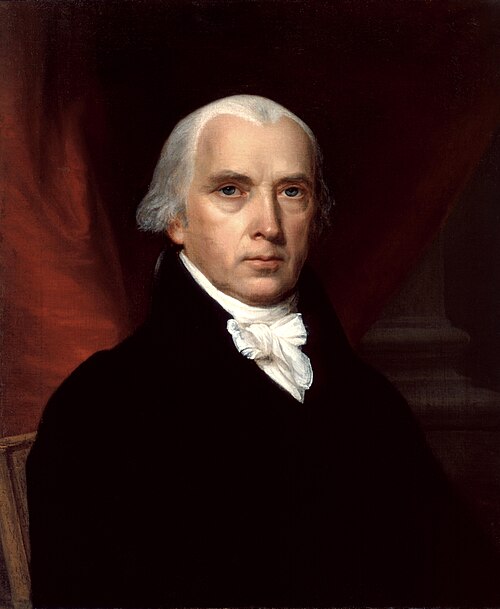
John Vanderlyn · Public domain
Known for
Separation of powers
Madison's argument that liberty is safest when the branches of government check one another, and that ambition must be made to counteract ambition.
Madison held that the accumulation of all powers in one body is the very definition of tyranny, and that the remedy is not good intentions but institutional design. Each department should have its own will and the means to resist the others.
In Federalist fifty-one he wrote that ambition must be made to counteract ambition, and that the rights of the people are protected by the rivalry among officeholders. The separation was never meant to be absolute; it was a system of checks whose friction was the price of liberty.
Faction and the extended republic
Federalist Number Ten: that a large republic controls the mischief of faction better than a small one.
Madison defined a faction as a group united by a common passion or interest adverse to the rights of others or to the permanent interest of the community. Since the causes of faction are sown in human nature, it cannot be removed without destroying liberty.
The cure, he argued, is to control its effects. A large republic contains more interests and parties than a small one, so that no single faction is likely to form a majority, and representation refines public opinion. The essay turned the size of the United States from a liability into an argument for the Constitution.
The Bill of Rights
The first ten amendments, which Madison drafted reluctantly and which became the republic's written guarantee of individual liberties.
Madison initially thought a bill of rights would be a paper barrier against a determined majority, and the Constitution's supporters had argued that the states' declarations were enough. But the promise of amendments was needed to secure ratification, and he made them his first order of business in Congress.
He distilled the state proposals into a set of limitations on the federal government, protecting speech, press, assembly, religion, and the rights of the accused. Ratified in 1791, the ten amendments became the foundation of American civil liberties and, through later incorporation, a check on the states as well.
Hosted
The framer's working dinner · 1787 · Philadelphia, Pennsylvania
Attended
A salon at Braintree · 1780 · Braintree, Massachusetts
A dinner during the Convention · 1787 · Philadelphia, Pennsylvania
Publius at table · 1788 · New York, New York
The orator's opposition · 1788 · Richmond, Virginia
The general's table at Mount Vernon · 1790 · Mount Vernon, Virginia
The farewell dinner · 1796 · Philadelphia, Pennsylvania
A dinner at Monticello · 1802 · Monticello, Virginia