Political philosophy and diplomacy
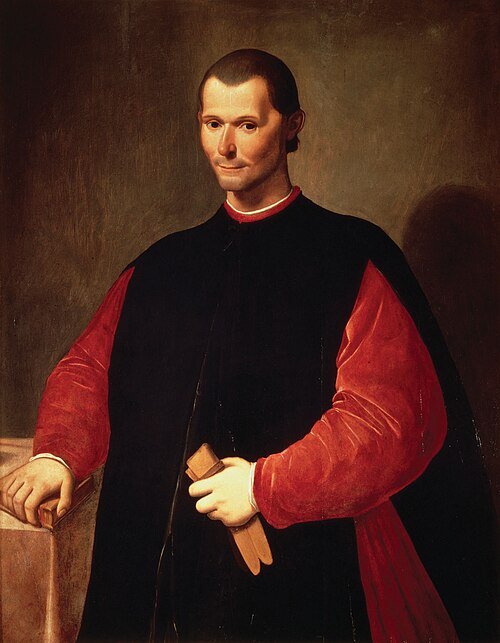
Niccolò Machiavelli
1469–1527 · Italy
Machiavelli was born in Florence in 1469 and entered the service of the republic in 1498 as a secretary and diplomat. For fourteen years he carried out missions to the courts of Italy and beyond, watching at close range how princes acquired and lost power.
When the Medici returned to Florence in 1512 he was dismissed, briefly imprisoned, and then retired to a small farm outside the city. There he wrote The Prince, a short book on how a new ruler should seize and keep a state, and the Discourses on Livy, a longer argument that republics are stronger when their citizens are armed and their institutions are sound.
His name became a byword for cunning, partly because his advice was stripped of the moralizing that earlier writers had wrapped around politics. In fact he wrote as an anatomist of power rather than an advocate for it, and his insistence that a statesman must reckon with how people actually behave made him the first modern political thinker. He died in 1527, the year the Medici were driven out again.
Santi di Tito · Public domain
Known for
The Prince
Machiavelli's short book on how a new ruler should win and hold a state, and why it has been read as both a manual and a warning.
Written in 1513 after Machiavelli lost his post with the Florentine republic, The Prince examines how a ruler who has recently acquired a state can keep it. Its method is to reason from history and from recent events rather than from Christian ethics, asking what actually works when a prince faces rivals, subjects, and fortune.
The book is famous for advising that a prince may have to be cruel, break faith, and appear virtuous without being so, if the survival of the state requires it. Whether Machiavelli meant this as advice, as a description of politics as it is, or as a covert attack on princely rule has been argued for five centuries. What is certain is that he separated the analysis of power from the moralizing that had surrounded it, and political thought has never quite recovered.
Republican virtue
Machiavelli's argument that free states endure only when citizens are armed, engaged, and willing to put the common good first.
In the Discourses on Livy Machiavelli set out the case for republics. He argued that a state which relies on mercenaries and leaves government to a single man is fragile, while one whose citizens bear arms, hold office in turn, and guard their laws is far more durable.
The virtue he had in mind was not private goodness but civic commitment: the willingness to serve, to fight, and to place the republic's survival above one's own advantage. He admired the Roman Republic because its institutions channeled conflict between the people and the nobility into strength rather than collapse. The lesson he drew was that liberty must be actively defended, or it is lost.
Virtù and Fortuna
Machiavelli's pair of forces: the skill and energy of a ruler set against the luck and circumstance no one controls.
Machiavelli described human affairs as a contest between virtù and fortuna. Virtù is not virtue in the Christian sense but the combination of ability, decisiveness, and force of will that lets a leader shape events. Fortuna is fortune, the river in flood that sweeps away the unprepared.
A wise prince builds dikes and embankments in calm weather, so that when fortune turns he has something to stand on. Machiavelli thought fortune governed perhaps half of what happens; the rest was open to skill. The image gave later readers a vocabulary for thinking about leadership, contingency, and the limits of planning.
Hosted
A study in exile · 1513 · Florence, Italy
Attended
The garden at San Marco · 1490 · Florence, Italy
A countess holds her court · 1490 · Forlì, Italy
A Borgia table in Rome · 1498 · Rome, Italy
The duke's banquet · 1502 · Rome, Italy
A commonwealth imagined · 1516 · London, England
The printer's house · 1520 · Basel, Switzerland