Physics, mathematics, and astronomy
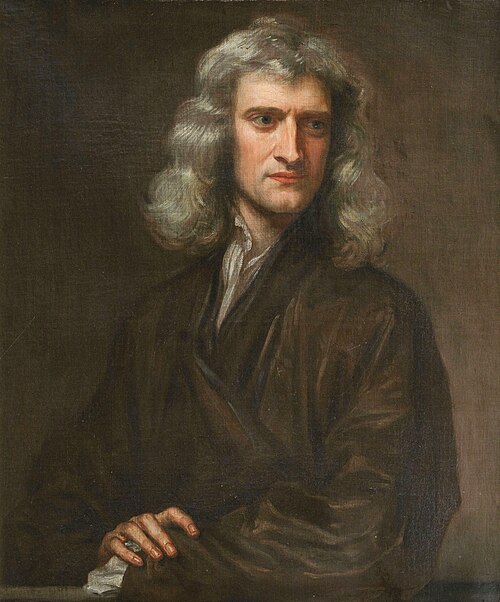
Isaac Newton
1643–1727 · England
Newton was born in a Lincolnshire farmhouse in 1643, after his father's death, and grew up solitary and mechanical. At Cambridge he read the new philosophy, and during the plague years at home he worked out the calculus, the composition of light, and the first hints of gravitation.
Principia Mathematica (1687) states the three laws of motion and the law of universal gravitation, showing that the fall of an apple and the orbit of the Moon obey the same mathematics. Opticks reported his experiments with prisms and light, and he was as committed to alchemy and biblical chronology as to mechanics.
He became president of the Royal Society and master of the Mint, was knighted in 1705, and quarrelled for years with Leibniz over the invention of the calculus. He died in London in 1727.
Godfrey Kneller · Public domain
Known for
Universal gravitation
Newton's claim that the same force pulling an apple down holds the Moon in its orbit and binds the planets to the Sun.
Before Newton, the heavens and the Earth were usually described by different rules. He proposed that a single force of attraction acts between any two masses, proportional to their sizes and weakening with the square of the distance between them, and that this one force explains both falling bodies and celestial orbits.
The Moon, he argued, is forever falling toward the Earth but moving sideways fast enough to keep missing it. The same mathematics accounts for the tides, for the paths of comets, and for the planets' obedience to Kepler's laws, which Newton showed follow from gravitation. It was the first great unification in physics, and it held until Einstein.
Hosted
Dinner at Trinity · 1687 · Cambridge, England
Attended
A lens grinder's table · 1665 · Amsterdam, Netherlands
A letter on toleration · 1685 · Amsterdam, Netherlands
An essay and two treatises · 1690 · London, England
Monads at Hanover · 1700 · Hanover, Germany