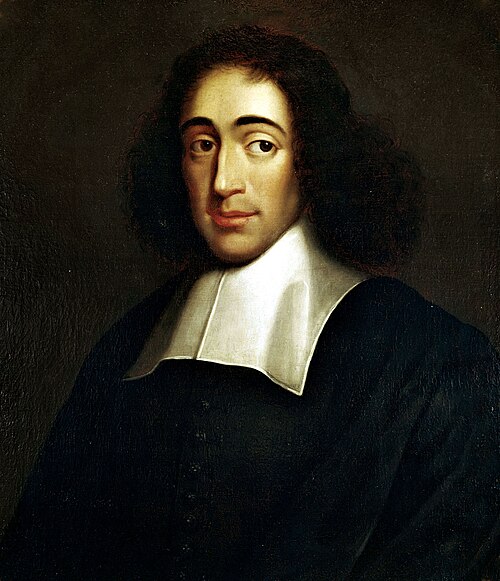
Philosophy and ethics
Baruch Spinoza
1632–1677 · Netherlands
Spinoza was born in Amsterdam in 1632 into a Portuguese-Jewish family that had fled the Inquisition. He was educated in the Jewish community, but his unorthodox views led to his expulsion in 1656, and he earned his living grinding lenses while living quietly in Dutch towns.
His Ethics sets out, in the form of geometric proofs, a single infinite substance that he calls God or Nature, in which thought and extension are two attributes. Mind and body are not two things but one seen in two ways; freedom is the understanding of necessity, and the passions can be ordered by reason.
He published the Theological-Political Treatise anonymously, arguing for freedom of thought and a critical reading of Scripture, and declined a professorship to keep his independence. He died in The Hague in 1677, his Ethics still unpublished.
anonymous · Public domain
Known for
God, or nature
Spinoza's single infinite substance in which mind and body are two aspects of the same reality.
Where Descartes found two substances, Spinoza found one. He argued that there can be only a single infinite substance, which he called God or Nature, and that everything else is a mode or modification of it. God is not a craftsman standing outside the world but the world's own necessity.
Thought and extension are not separate things but two attributes under which the one substance is understood. A human being is a mode of both: the mind is the idea of the body, and the body is the object of the mind. From this followed his ethics — that freedom is not the absence of cause but the clear understanding of what causes us, and that the highest good is the intellectual love of God.
Hosted
A lens grinder's table · 1665 · Amsterdam, Netherlands
Attended
The wager at Port-Royal · 1655 · Paris, France