Philosophy, mathematics, and diplomacy
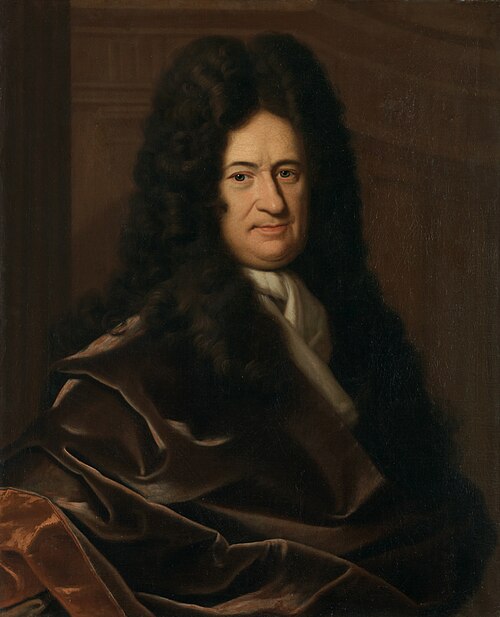
Gottfried Wilhelm Leibniz
1646–1716 · Germany
Leibniz was born in Leipzig in 1646 and educated in philosophy and law; he spent his career as a court counsellor and diplomat at Hanover and elsewhere, and traveled widely. He was one of the last thinkers to work confidently across every field.
He invented a calculating machine that could multiply and divide, devised a binary arithmetic he believed had deep significance, and published his version of the calculus before Newton did, setting off a bitter dispute over priority. In philosophy he argued that the world is made of simple substances called monads, that mind and body run in a pre-established harmony, and that this is the best of all possible worlds.
He founded the Berlin Academy and wrote on history, law, theology, and logic. He died in Hanover in 1716, out of favour with his employer, and his philosophical works were published only after his death.
Christoph Bernhard Francke · Public domain
Known for
The calculus
The mathematics of change and accumulation, invented independently by Newton and Leibniz and the subject of a bitter priority dispute.
The calculus answers two linked questions: how fast something is changing at a moment, and how much accumulates over an interval. Newton developed his version, which he called fluxions, in the 1660s and used it to work out motion and gravitation, but he published it only years later.
Leibniz arrived at the same mathematics independently and published first, in 1684, with notation that proved clearer and more usable than Newton's. For decades their supporters accused each other of theft, and the quarrel divided British and continental mathematics. Modern notation is largely Leibniz's, and the consensus is that each discovered the calculus for himself.
Pre-established harmony
Leibniz's picture of mind and body as two clocks set by God to keep perfect time without ever touching.
Leibniz denied that mind and body can act on one another, because on his view each monad is a self-contained simple substance with no windows onto the rest. Yet experience shows them running in step: a decision and a movement, a wound and a pain.
His solution was that God, in creating the world, arranged each substance so that its internal development would correspond exactly with every other. He compared mind and body to two clocks made with such skill that they always agree, though neither influences the other. The harmony is not maintained moment by moment but fixed once, at creation.
Hosted
Monads at Hanover · 1700 · Hanover, Germany
Attended
A lens grinder's table · 1665 · Amsterdam, Netherlands
A letter on toleration · 1685 · Amsterdam, Netherlands
Dinner at Trinity · 1687 · Cambridge, England
An essay and two treatises · 1690 · London, England