Political philosophy and epistemology
John Locke
1632–1704 · England
Locke was born in Somerset in 1632, the son of a lawyer, and studied at Oxford, where he took up medicine and natural philosophy. He served as physician and adviser to the Earl of Shaftesbury, and political trouble sent him into exile in the Netherlands.
An Essay Concerning Human Understanding argues that there are no innate ideas: the mind is at first a blank page, and all knowledge comes from experience and reflection. Two Treatises of Government grounds authority in a social contract and in natural rights to life, liberty, and property, and defends the right of a people to resist a government that betrays its trust.
His Letter Concerning Toleration argued for a wide freedom of conscience. He returned to England after the revolution of 1688 and died at Oates in 1704.
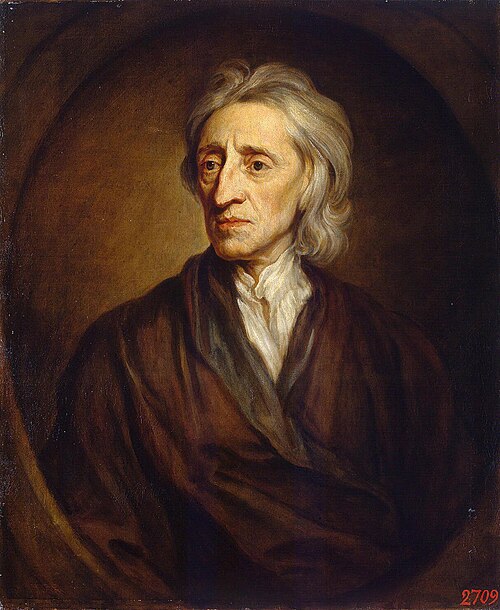
Godfrey Kneller · Public domain
Known for
The social contract
Locke's account of government as a trust held from the people, revocable when it fails them.
Locke imagined people first living without government, equal and free, but inconvenienced by the absence of a settled law and a judge. To remedy that, they agree to form a political society and entrust a government with limited powers for the common good.
The trust runs one way. Government exists for the people, not the people for government, and it holds its authority only so long as it protects their rights. If a ruler turns against the ends of the trust, the people may alter or abolish the government and constitute a new one. Written in defence of the revolution of 1688, the argument was read a century later as a justification for revolution in America and France.
Natural rights
Life, liberty, and property as claims that precede government and that government exists to protect.
Locke held that certain rights belong to people by nature, before any government exists: the right to preserve one's own life, the liberty to order one's own actions, and the ownership of what one has mixed one's labour with. These are not gifts from the state and cannot be surrendered by entering society.
Government is formed precisely to secure them. That made the rights a standard against which laws could be judged, and it gave later revolutionaries a vocabulary for saying that a government which violates them forfeits its claim to obedience. The phrase 'life, liberty, and property' became, in Jefferson's hands, 'life, liberty, and the pursuit of happiness'.
Hosted
A letter on toleration · 1685 · Amsterdam, Netherlands
An essay and two treatises · 1690 · London, England
Attended
The wager at Port-Royal · 1655 · Paris, France
Dinner at Trinity · 1687 · Cambridge, England
Monads at Hanover · 1700 · Hanover, Germany