Independence, the presidency, and the agrarian republic
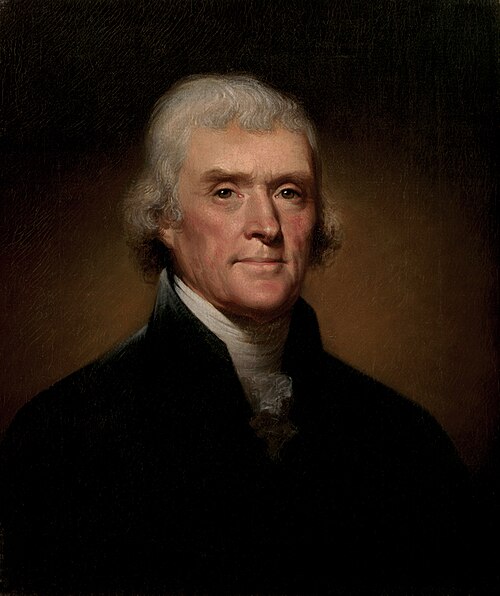
Thomas Jefferson
1743–1826 · United States
Jefferson was born in 1743 at Shadwell, Virginia, into a family of planters, and studied law at the College of William and Mary. He entered the Virginia House of Burgesses young and wrote early in his career a pamphlet, A Summary View of the Rights of British America, that made him known as a bold defender of colonial rights.
In 1776 the Continental Congress asked him to draft the Declaration of Independence, whose argument that governments derive their just powers from the consent of the governed became the founding statement of the republic. Back in Virginia he wrote the Statute for Religious Freedom and worked to reform the laws of inheritance and education along republican lines.
He served as governor of Virginia, as minister to France, and as Washington's first secretary of state before becoming president in 1801. His administration completed the Louisiana Purchase, sent Lewis and Clark westward, and kept the country out of the Napoleonic wars. He founded the University of Virginia in retirement and died at Monticello on the Fourth of July, 1826.
Rembrandt Peale · Public domain
Known for
The Declaration of Independence
Jefferson's draft, its argument from natural rights, and the compromises the Congress made in editing it.
Jefferson wrote the Declaration in a little over two weeks in June 1776, drawing on Locke and on the language of the Virginia Declaration of Rights. Its central claim is that all men are created equal and are endowed with unalienable rights, and that governments derive their just powers from the consent of the governed.
The Congress cut about a quarter of the draft, including a passage blaming the king for the slave trade, and adopted the rest on July 4. The document was a declaration of war as much as a statement of philosophy, but its argument outlived the conflict and became the standard against which the republic's own failures would be measured.
The Louisiana Purchase
The 1803 deal that doubled the nation's territory, and the constitutional scruples Jefferson overcame to make it.
When Napoleon offered to sell France's North American claim for fifteen million dollars, Jefferson faced a dilemma: the Constitution granted no explicit power to acquire territory. He drafted an amendment, then let it drop when his advisers warned that delay would lose the deal.
The purchase added some 828,000 square miles between the Mississippi and the Rockies and made the United States a continental power. Jefferson sent Lewis and Clark to explore it, and the question of whether the new states would permit slavery made the acquisition the beginning of a long political crisis.
Religious freedom in Virginia
Jefferson's Statute for Religious Freedom, which disestablished the church and made belief a matter of private conscience.
In Virginia the Anglican Church was established by law, and dissenters were taxed to support it. Jefferson drafted a statute in 1777 declaring that no one should be compelled to attend or support any religious worship, and that the mind cannot be forced.
Madison guided it through the legislature in 1786 after a long campaign against a general assessment for religion. The statute ended establishment in Virginia and became the model for the First Amendment's religion clauses. Jefferson was prouder of it than of his presidency and asked that it, along with the Declaration and the University of Virginia, be inscribed on his tomb.
Hosted
A dinner at Monticello · 1802 · Monticello, Virginia
Attended
The evening before independence · 1776 · Philadelphia, Pennsylvania
The pamphleteer's table · 1776 · Philadelphia, Pennsylvania
A salon at Braintree · 1780 · Braintree, Massachusetts
The orator's opposition · 1788 · Richmond, Virginia
The general's table at Mount Vernon · 1790 · Mount Vernon, Virginia
The farewell dinner · 1796 · Philadelphia, Pennsylvania
The president and the sedition laws · 1798 · Philadelphia, Pennsylvania